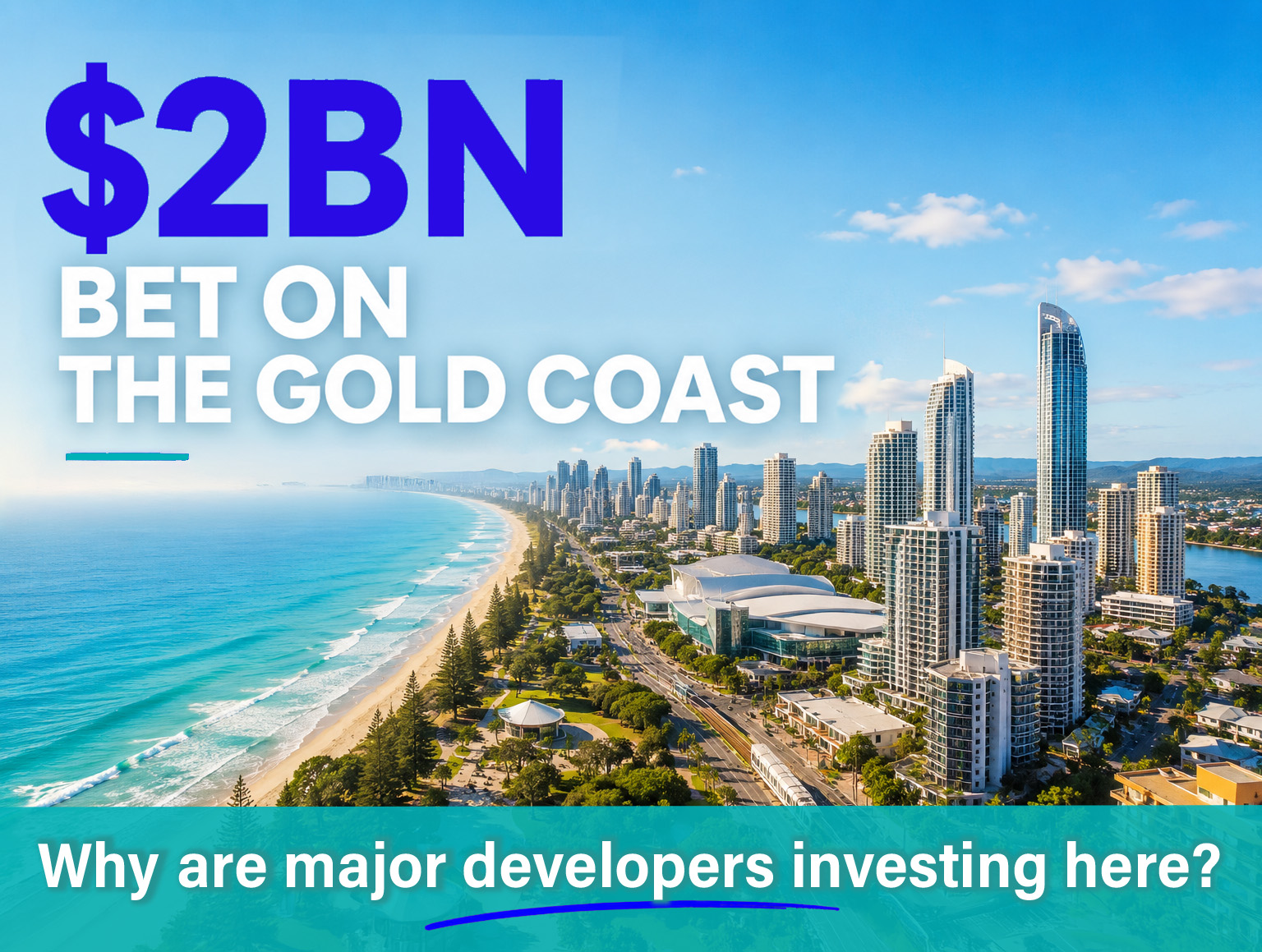
A major international developer has committed to a landmark Broadbeach project worth around $2 billion. But the bigger story isn’t simply two new towers — it’s what this level of investment may tell us about confidence in the Gold Coast’s next phase of growth.
The Gold Coast has long been known for its beaches, lifestyle and tourism. But increasingly, it is also attracting the attention of major national and international property groups.
The latest example is UAE-based developer Arada, which has announced plans for an AED5 billion — approximately A$2 billion — twin-tower residential development in Broadbeach.
The project will deliver 952 residences, approximately 1,200sqm of retail and hospitality space, extensive resident amenities and is targeted for completion ahead of the 2032 Olympic and Paralympic Games. It represents Arada’s first Australian development outside New South Wales and, according to the company, its most significant Australian commitment to date.
But rather than focusing on another pair of towers changing the skyline, we think there is a more interesting question:
Why are major developers investing in the Gold Coast now?
1. The Gold Coast is becoming more than a lifestyle market
For decades, the Gold Coast property story was heavily associated with tourism, holiday apartments and lifestyle buyers.
That identity remains important, but the city is evolving.
Arada specifically cited population growth, interstate migration, major infrastructure investment and the Gold Coast’s enduring lifestyle appeal when explaining its confidence in the market. The developer also described the city as evolving into an increasingly sophisticated and globally recognised destination.
For major developers making long-term investment decisions, these underlying fundamentals can matter considerably more than short-term movements in property prices.
A development of this scale takes years to plan, build and sell. The decision therefore represents a view not just on today’s Gold Coast, but on where the city may be heading over the next decade.
2. Broadbeach offers something increasingly difficult to replicate
Location matters.
The development site sits directly opposite the Gold Coast Convention and Exhibition Centre, with light rail immediately accessible and Pacific Fair and The Star within walking distance. It combines beachside living with established retail, dining, entertainment and transport infrastructure.
That combination helps explain why Broadbeach continues to attract premium development.
It isn’t simply about being close to the beach.
It is the combination of:
Lifestyle + transport + retail + employment + entertainment + limited premium sites.
For property investors, this is an important distinction. New development alone doesn’t necessarily create long-term value. The surrounding infrastructure, amenity and depth of demand are equally important.
3. Major infrastructure investment is changing the equation
The Gold Coast’s growth is also being accompanied by significant transport and infrastructure investment.
The Queensland Government recently announced new east-west GC Surfer metro-style services, including a Nerang-to-Broadbeach connection linking heavy rail, light rail, major sporting venues and the Convention Centre. Major upgrades to Nerang–Broadbeach Road are also planned.
That sits alongside other major transport initiatives, including the Logan and Gold Coast Faster Rail project, further Gold Coast public-transport investment and planning for longer-term connections.
This matters because property development and infrastructure rarely operate independently.
As connectivity improves, areas can become more accessible to residents, workers and visitors — potentially broadening the pool of people willing to live, work and invest there.
4. Is 2032 really driving Gold Coast property investment?
Yes — but we wouldn’t attribute everything to the Olympics.
The 2032 Olympic and Paralympic Games are clearly accelerating infrastructure planning and bringing international attention to South East Queensland. The Queensland Government’s 2032 Delivery Plan includes Gold Coast venue upgrades, an Athlete Village and major transport initiatives.
Arada itself has linked its investment case partly to the Games and expects the period leading to 2032 to support demand for quality residential property across South East Queensland.
But 2032 is better viewed as an accelerator rather than the entire reason for investment.
Population growth, migration, lifestyle appeal, constrained premium locations and infrastructure investment would remain important property-market fundamentals even without the Games.
That is an important distinction for buyers and investors.
Buying property purely because “the Olympics are coming” is not an investment strategy.
Understanding how the infrastructure and economic changes associated with 2032 may affect individual locations is far more useful.
5. International capital is taking a longer-term view
There is another reason this announcement caught our attention.
Arada only entered Australia in 2024. Since then, it says it has assembled a pipeline of eight projects and more than 5,000 homes nationally. The Broadbeach development represents its first move beyond NSW.
Choosing the Gold Coast for that expansion is significant.
It doesn’t guarantee future property growth, nor does one $2 billion project determine the direction of an entire market.
But it does provide another indication that sophisticated property groups are looking at the Gold Coast through a longer-term investment lens — considering where population, infrastructure, lifestyle demand and urban development may intersect.
What could this mean for existing property owners?
A $2 billion development doesn’t automatically mean nearby property prices will rise.
In fact, major new projects introduce additional supply and competition as well as investment and amenity.
The effect can be very different depending on the property.
An established apartment competing directly with hundreds of new luxury apartments may face a different market dynamic from a house in a tightly held suburb where new supply is extremely limited.
Likewise, properties near improving transport and amenity may experience different demand patterns from properties further away.
This is why we believe owners should look beyond the headline “Gold Coast is growing.”
The more useful questions are:
Where is the investment going? What infrastructure is following it? What new supply is coming? And which types of property are difficult to replace?
What should buyers and investors be watching?
The same principle applies to buyers.
A large development pipeline can be a sign of confidence — but it doesn’t mean every new project or every Gold Coast suburb represents the same opportunity.
We would be watching four things particularly closely:
Infrastructure — where transport and public investment are improving connectivity.
Supply — how much competing housing is actually coming into a particular micro-market.
Demand — who is buying or renting there, and whether that demand is local, interstate, international or investor-driven.
Scarcity — what makes an individual property or location difficult to reproduce.
Those factors often tell us much more than a city-wide headline.
Our View: The Bigger Story Isn’t Just $2 Billion
The Arada announcement is eye-catching because of its size.
But the $2 billion figure isn’t the most important part of the story.
What interests us is why an international developer making a long-term commitment to Australia has selected the Gold Coast — and Broadbeach in particular — for its next major expansion.
The answer appears to be a combination of population growth, lifestyle demand, established amenity, infrastructure investment and confidence in the city’s longer-term evolution, with 2032 providing an additional catalyst.
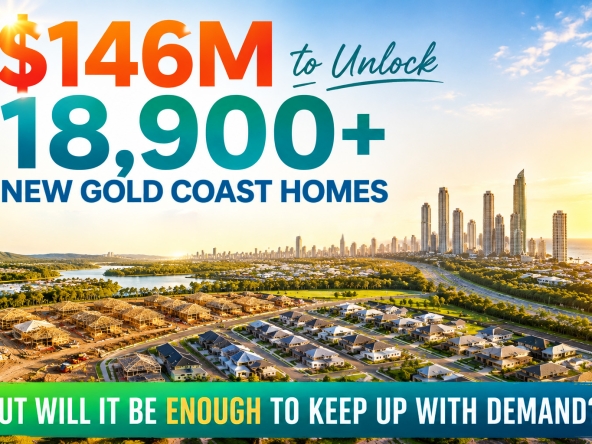
Last week, we looked at the Queensland Government’s $146 million commitment to help unlock more than 18,900 future Gold Coast homes.
This week, we’re seeing another side of the same broader story: private capital positioning for the city’s future growth.
Neither announcement tells us exactly what property prices will do next.
But together, they show something worth watching:
The Gold Coast is preparing for its next stage of growth — and significant public and private investment is following.
For homeowners, buyers and investors, the opportunity is not simply to follow the biggest headline.
It is to understand where that growth is happening, what is driving it, and which properties are best positioned within a changing Gold Coast.
Thinking About Your Next Property Move?
Whether you’re considering selling, buying or investing, understanding how new supply, infrastructure and development activity may affect your particular property or suburb is increasingly important.
Speak with Opal Realty Group about your property strategy →
Sources: The analysis above is based primarily on Arada’s 20 August 2026 announcement and Queensland Government information on Gold Coast transport and 2032 infrastructure.
I think this is a stronger article than simply writing “New $2BN Broadbeach Development Announced.” It uses the project as the hook, but the actual content positions Opal as interpreting what major investment tells us about the Gold Coast market.